
Beyond the Language Model: Why Building Truly Agentic AI Means Engineering the Whole Brain
It seems like every software company today is talking about Agents as the next phase of Artificial Intelligence revolution. But what makes an AI Agent more intelligent than a Large Language Model (LLM), if it based on the same underlying technology? And if an AI Agent needs more than “just” an LLM to run, how do we design intelligent systems to deliver the full promise of agentic AI?
If you want to understand the true nature of intelligence, you have to look beyond words. A chimpanzee carefully stripping leaves off a twig, that it then uses to fish ants out of a nest is displaying remarkable intelligence. A toddler figuring out how to angle a spoon to successfully feed themselves is demonstrating complex, physical problem-solving. Neither of these actions requires language. True intelligence is fundamentally about interacting with an environment, adapting to friction, using tools, and successfully achieving goals.
Yet, because Large Language Models (LLMs) are so incredibly articulate, we have fallen into the trap of equating linguistic fluency with full intelligence.
When enterprises first deploy AI, they typically start with a language model that can answer questions, summarise documents, draft emails, and hold a conversation. The results are impressive enough to generate excitement, but often frustrating enough to generate doubt. The AI says something plausible but entirely wrong. It forgets what you told it last week. It can perfectly describe what needs to happen, but it can't actually execute the task. It works brilliantly in isolation and falls apart in a real business workflow.
The problem isn't the model itself. The problem is that we've handed a disembodied frontal lobe a task that requires an entire body, brain and nervous system to complete.
This is where agentic design patterns come in – they provide an approach for us to connect a disembodied LLM brain with the real-world environment, giving it the ability to plan, act, reason, reflect and learn. Instead of just replying to user inputs in a turn-based chat conversation, an agent can react to events and use tools to achieve goals, allowing us to design automation systems that can emulate the intelligent behaviour exhibited by humans.
Intelligence Is More Than Language
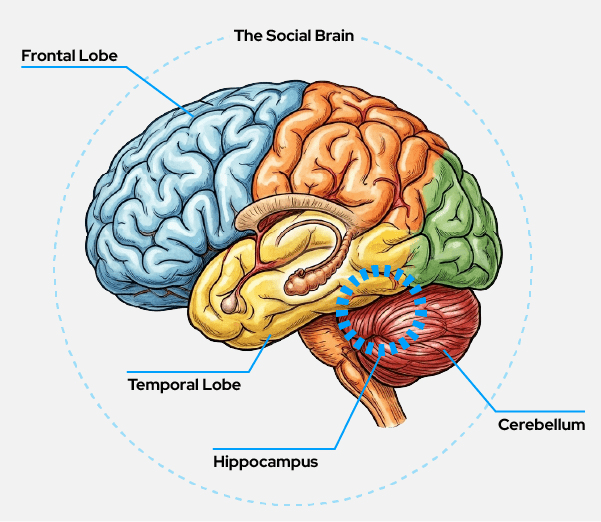
Human intelligence didn't evolve all at once, and while the brain is talked about as a single organ, in fact it is composed of interconnected, specialised regions that work together to produce human intelligence.
The brain stem came first to manage autonomic functions, process sensory input, and keep the organism alive – it regulates subconscious activities like breathing that are vital for the organism’s survival. Then came the cerebellum to coordinate movement and learned physical routines. The occipital lobe developed the ability to process visual signals to recognise patterns and movement. The parietal lobe specialises in processing signals like touch, pain or temperature, as well as playing an important role in spatial awareness and navigation. The limbic system added memory and emotional weighting. The temporal lobe gave us language. Finally, relatively recently in evolutionary terms, the prefrontal cortex in the frontal lobe arrived to bring abstract reasoning, planning, self-correction, and the ability to coordinate with other minds toward a shared goal.
Each layer built on the last. Remove any one of them, and the whole system degrades in a specific, predictable way. A person with a damaged hippocampus can still speak fluently, but they just can't form new long-term memories, for example if they suffer from amnesia or Alzheimer’s disease. A person with a damaged frontal lobe can still recall facts, but they struggle to plan or self-regulate.
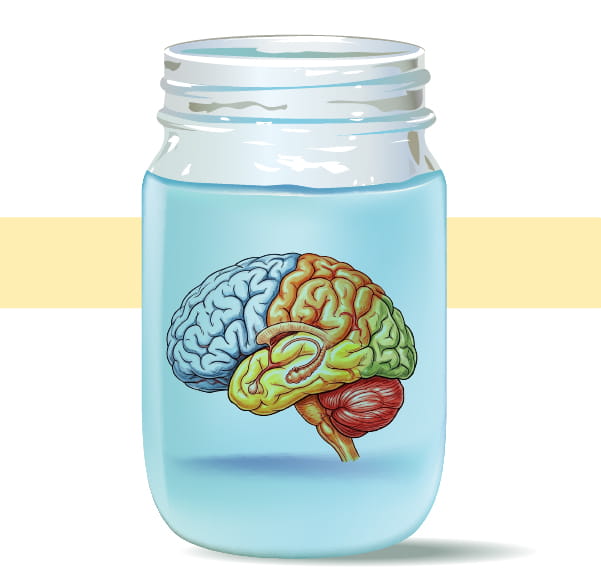
The exact same principle applies to AI systems. An LLM without memory, tools, planning, or the ability to collaborate with other agents is essentially a temporal lobe floating in a jar. It is impressive in its own way, but virtually useless in practice.
The good news is that we don't have to wait millions of years for evolution to take its course. We can engineer these capabilities deliberately, layer by layer, and combine them in ways that biological evolution never could. This is what agentic AI design patterns are really about. We are building a new kind of artificial intelligence with full intentionality about what each layer does and why.
Let's walk through the five levels of building a complete "AI brain", mapping this to levels of agency or autonomy that can be achieved by AI agents.
Deterministic

Self-Directed





The Five Levels of Building an “AI Brain”
1: The Language Model (Temporal Lobe Only)
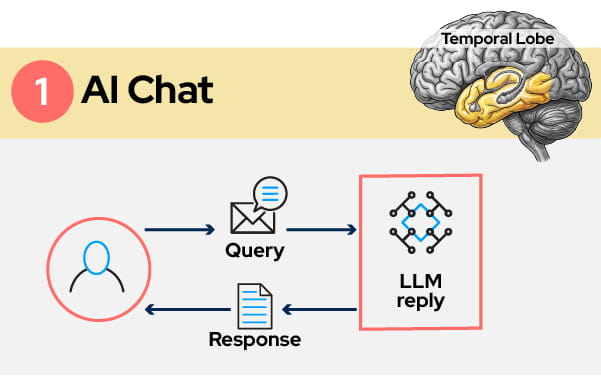
At its core, this is conversational AI that generates responses based on its training data. Think of chat interfaces, summarisation tools, and basic Q&A bots. It can communicate, reason over what it already knows, and generate text or code from a simple prompt. However, it can't access your live data, remember your last conversation, take action in a system, or know what happened last Tuesday.
In brain terms, the temporal lobe handles language and the recall of learned knowledge. But on its own, it has no persistent memory of your life, no hands, no ability to plan, and no awareness of other minds in the room.
Most enterprise AI tools today sit right here, they provide access to a Large Language Model, perhaps with some embedded prompts and data to shape how the LLM responds. They are genuinely useful but also inherently limited, and their ceiling tends to show up exactly when a business process needs to continue outside the chat window.
2: The Retrieval Agent (Adding the Hippocampus)
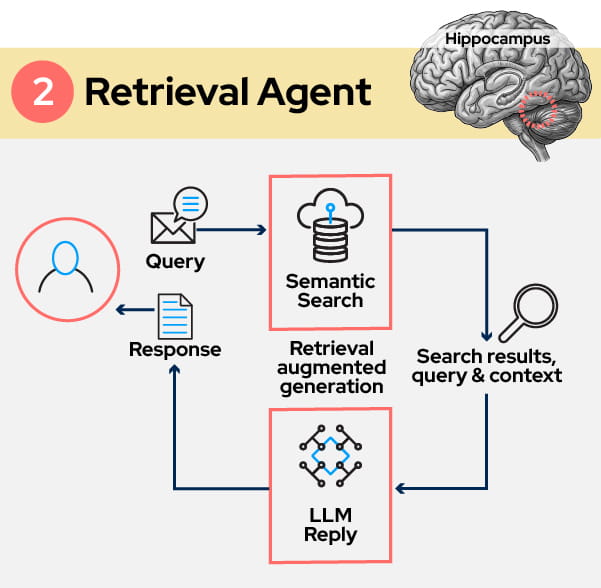
This level introduces an AI grounded in your organisation's own content via Retrieval Augmented Generation (RAG). It can search a curated knowledge base or the web, retrieve relevant information, and cite its sources. This gives the system long-term memory that relies not just on the model's public training data, but your actual proprietary data, like product documentation, policies, contracts, case history, and reports, as well as up to the minute information from sources on the web.
The hippocampus is the brain's indexing system. It encodes experiences into long-term memory and retrieves them when relevant. Without it, the brain can only work with what it knew at birth. RAG serves as the hippocampus for an AI agent.
Where artificial systems pull ahead is that a human's hippocampus degrades with age and stress. An AI knowledge base doesn't forget, doesn't misremember under pressure, and can be updated centrally the exact moment a policy changes. It can search across millions of documents in milliseconds with deep semantic understanding rather than simple keyword matching.
We explored the nuances of getting this right in our post on RAG and knowledge quality because retrieval accuracy matters enormously. The exact RAG approach used directly impacts retrieval accuracy and needs to be aligned to the requirements of your use case. In terms of agent design, this is the difference between implementing an agent with a good or bad memory!
Often the process an agent uses to learn new information builds on other specialist functions. For example, one bank we worked with used the Knowledge Discovery agent in TotalAgility Enterprise to identify currency and interest rate hedging positions from complex annual reports and financial statements. Before this information could be stored in the Knowledge Base for future recall and use, the system needed to visually identify and map the tables containing the desired data. In our analogy, the use of OCR (Optical Character Recognition), Machine Learning and Computer Vision to recognise and lift data from tables is the equivalent to our agent’s occipital lobe, which processes visual signals passed into the brain from the eyes.
3: The Worker or Tool Use Agent (Adding the Cerebellum)
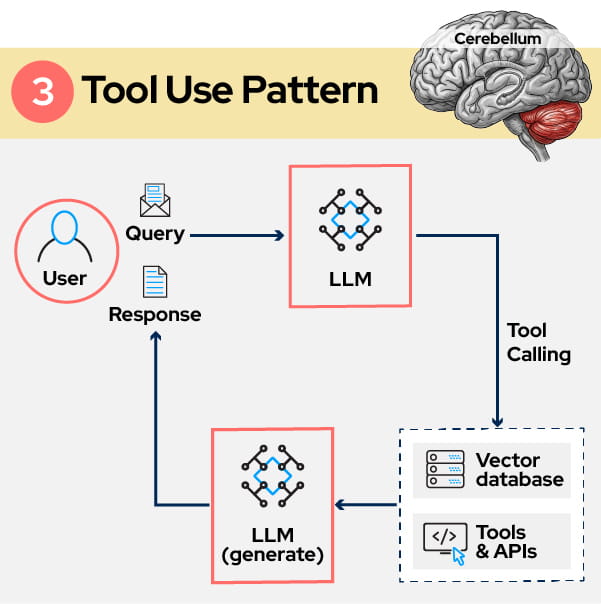
Here, the AI evolves from finding information to taking action. It can call APIs, update CRM records, trigger workflows, run Robotic Process Automation (RPA) bots, and write directly to databases. The tool-use agent transforms the agent from a passive advisor into an active participant in your business process.
Think of the cerebellum, which coordinates learned, repeatable physical actions. It provides the muscle memory that lets you type without thinking about individual keystrokes or drive a familiar route on autopilot. Worker agents operate similarly. They are configured to have a defined repertoire of digital tools they can select to use and know exactly how to invoke them reliably to fulfil a request.
The major advantage here is that human muscle memory is slow to acquire and hard to update. Tool or skill registries in an agentic platform can be extended with new capabilities instantly, shared across every agent in the system simultaneously, and governed centrally with strict role-based access controls. A tool that one agent learns to use is immediately available to all permitted agents.
This pattern is what separates an AI that produces output from an AI that creates actual outcomes. The tool to use is dynamically selected based on the request from the user or the event that is being processed. The AI model doesn’t need to figure out how to use the tool, the actual mechanics of calling the APIs are handled by the automation system – the LLM just needs to decide which tool should be called. Similar to a human writing something down, that person doesn’t need to think through how to move their hand to write each letter, it is handled subconsciously – they just need to think about what they want to write, and the cerebellum handles transmitting the nervous signals to move the required muscles.
4: Managing or Planning Agent (Adding the Frontal Lobe)
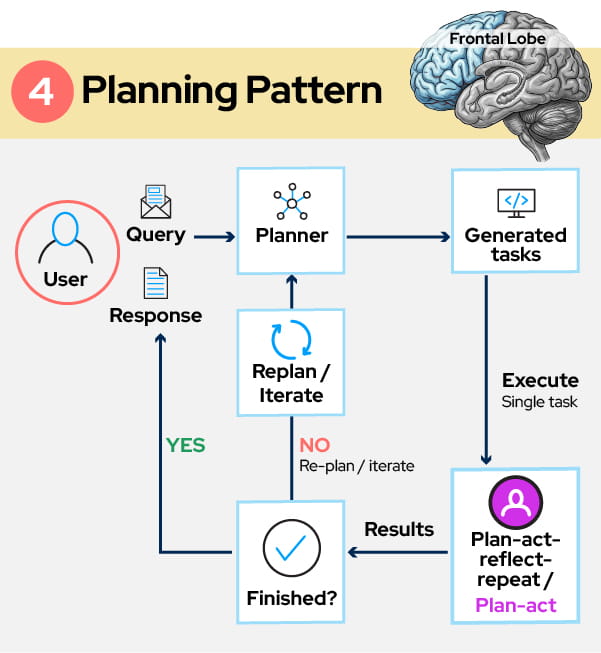
At this stage, we see an AI that can decompose a complex, multi-step goal into a distinct plan, execute against it, reflect on what happened, and adapt dynamically. This represents the planning pattern, and at its most sophisticated, it operates as Plan, Act, Reflect, and Repeat (PARR) loop. Here a managing agent assesses the task at hand, then decomposes it into a number of steps that can be fulfilled by using tools, calling worker agents or accessing information via retrieval agents. It brings true reasoning under uncertainty. The agent doesn't just blindly respond to a prompt. It sets its own sub-goals, sequences its actions, evaluates its own output, and decides whether to continue, revise, or escalate to a human.
The prefrontal cortex in the frontal lobe is the seat of executive function, managing planning, impulse control, self-monitoring, and goal-directed behaviour. It is the part of the brain that stops to ask if the current approach is actually working and changes course if the answer is no. The Reflection pattern, where the agent critiques its own output before presenting it, is the AI equivalent of this critical self-regulatory loop. Indeed, many people report having an inner voice or internal monologue that uses language to structure their thoughts, which neurological is linked to an area of the frontal lobe called Broca's Area. In this pattern the LLM of the managing agent is like an inner voice, forming a plan and assessing results using language. By designing agents to record and store their plans and analysis, we can capture an audit trail of everything the agent’s inner voice “thought”.
Human executive function is easily exhausted. Decision fatigue, cognitive bias, and emotion all degrade the quality of our planning over time. An AI case manager, however, applies the exact same structured reasoning to the thousandth case as it does to the first. It provides a complete audit trail of every decision and the ability to replay, sample, and benchmark performance at any point. And by leveraging additional LLM steps in an automation, an agent can summarise its plan, actions and self-reflect on its success (or lack of), storing these learnings in a knowledge base for future retrieval to provide insights to guide the agent if needs to perform a similar task in the future.
5: Multi-Agent Systems (The Social Brain)
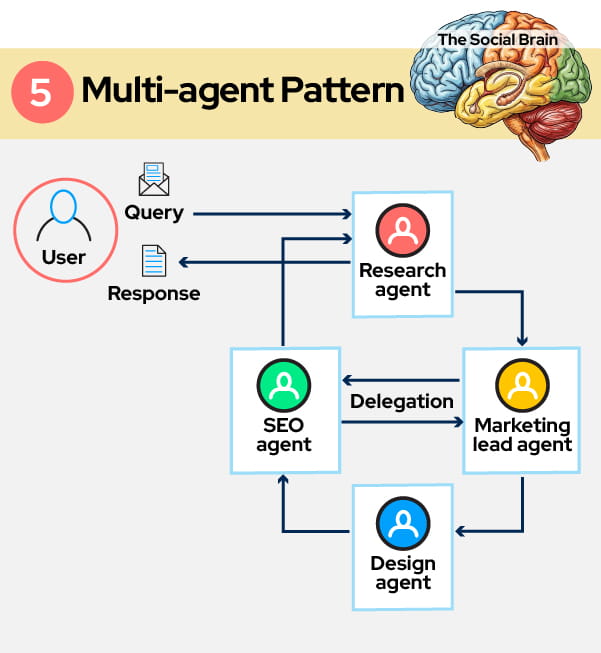
The highest level is a coordinated community of specialised agents. Each has its own tools, instructions, and scope, all orchestrated by a managing agent that owns the overall goal and controls the lifecycle of the case. This setup provides a division of cognitive labour, parallel processing, and deep specialisation without fragmentation. It handles complexity that would easily exceed any single agent's context window or capability.
No individual brain region works in isolation. The brain's most sophisticated functions emerge from networks of specialised regions communicating through well-defined pathways. A multi-agent system perfectly mirrors this architecture. A managing agent plays the role of the prefrontal cortex by setting goals, arbitrating conflicts, and integrating outputs. Meanwhile, worker agents handle perception, memory retrieval, tool execution, and validation simultaneously in the background.
Human teams are often slow to assemble, expensive to coordinate, and constrained by traditional working hours. Agent teams can be spun up in seconds, run in parallel without communication overhead, and be reconfigured simply by changing a registry entry rather than restructuring an entire organisation. New specialist agents can be added modularly without breaking the workflows that already succeed.
Here the best agent teams combine both human and AI workers. One of our partners has developed an agentic solution for medical insurance cover. An agentic case management approach handles bespoke insurance applications across multiple channels and formats. This highly non-linear process previously required expensive and slow specialist review. Now, specialist AI agents pre-read communications and surface issues for human supervisors who retain final decision authority. The human stays in the loop exactly where they add value, while the agents handle the heavy preparation and analysis that used to consume the specialist's entire day.
Building the Whole Brain
This article has explored how we can combine the language and reasoning capabilities of the latest LLMs, with more deterministic automation capabilities and proven design patterns, to create intelligent systems that go far beyond text or image generation, to behave with purpose in real world environments. The five patterns that correspond to these levels (RAG, Reflection, Tool Use, Planning, and Multi-Agent) are not independent choices. They are cumulative layers. Each one builds heavily on the capabilities beneath it. A planning agent without memory has no long-term learning. A multi-agent system without tool use has no way to act on its conclusions. The architecture must be layered, just like the brain itself.
At Tungsten Automation, TotalAgility is designed around exactly this principle. It is a platform where each layer is a first-class capability that is governed, auditable, and easily composable with the others. It isn't a collection of separate AI products awkwardly stitched together. Instead, it is a single unified architecture that scales from a basic chat agent to a fully autonomous multi-agent system, providing complete visibility into every decision at every level.
Evolution took 500 million years to build the human brain. We are building the agentic equivalent deliberately, with strict governance built in from the very start.
Explore the design patterns in depth:
Ready to assess where your organisation sits on the agentic maturity spectrum? Talk to a TotalAgility expert.

Agentic AI Design Patterns for Enterprise AI Systems
This post is part of a dedicated series exploring how Agentic AI Design Patterns help enterprises build reliable, governable, and scalable AI agents. Here we provide an overview of the Reflection, Multi-Agent, Tool-Use and Planning Patterns.
More in this series:
- Agentic AI Design Patterns: An Overview - A high-level introduction to agentic AI systems and the core design patterns used in enterprise environments.
- The Agentic AI Reflection Pattern - How structured self-review loops improve accuracy, reduce hallucinations, and introduce validation safeguards in enterprise AI systems.
- The Agentic AI Multi-Agent Pattern - Designing AI systems where specialized agents collaborate to handle complex, multi-step workflows.
- The Agentic AI Tool-Use Pattern - Enabling AI agents to interact with external tools, APIs, and enterprise systems to take real-world action.
- The Agentic AI Planning Pattern - How structured planning and task decomposition support long-running, goal-driven AI workflows.

Gartner® erkennt Tungsten Automation in seinem ersten Magic Quadrant™ für Intelligent Document Processing (IDP) -Lösungen als führenden Anbieter an.
Bericht abrufen
Kontaktieren Sie uns
Vernetzen Sie sich mit einem Experten von Tungsten Automation, um mehr über unsere Lösungen zu erfahren.

Demo anfordern
Erfahren Sie in einer personalisierten Demoversion aus erster Hand, wie wir Ihnen in Sachen Innovationen und Produktivität unter die Arme greifen und Sie dabei unterstützen können, Ihren Geschäftserfolg voranzutreiben.