

Paper Records Backlogs in Government and the Hidden Cost of Manual Intake and Processing
Paper backlogs are not just frustrating. They are where government records programs quietly lose control.
I see this pattern across agencies. Not because teams are careless, but because manual processing turns consistency into a best-effort exercise. When volume spikes, the process does what manual processes always do. It slows down, it gets inconsistent, and it creates more opportunities for mistakes that only show up when it is too late to undo them.
When records arrive on paper, agencies inherit a chain of manual steps before anything becomes searchable, trackable, or releasable.
That is the hidden cost of paper and manual processing. Not just time. Exposure.
As backlogs grow, the process failures become predictable:
- Deadlines slip because intake and review become the bottleneck
- Similar requests get handled differently depending on who touches them
- Redaction becomes riskier under pressure, especially when teams are overloaded
- Documentation gets thin, which makes it harder to prove consistent handling later
This is how agencies end up in the worst place possible. Working hard, moving slowly, and still being vulnerable to the thing they cannot afford: an inconsistent release decision, a missed deadline, or a privacy mistake that damages public trust.
This is exactly what the new GovWhitePapers report, Reimagining Government Records in the Age of AI, explores through three expert perspectives. I contributed my point of view based on what I have seen work in real records environments, and where records workflows are heading next as agencies work to reduce manual burden while strengthening consistency and control.
Two signs your paper backlog is becoming a liability:
- Your team spends more time preparing records than completing the mission work those records support.
- You rely on heroics, tribal knowledge, and last-minute reviews to hit response timelines and SLAs.
If either is true, you are not alone, and survey data backs this up. State and federal agencies cite manual processes and data accuracy/completeness as two of the biggest challenges in records management today.
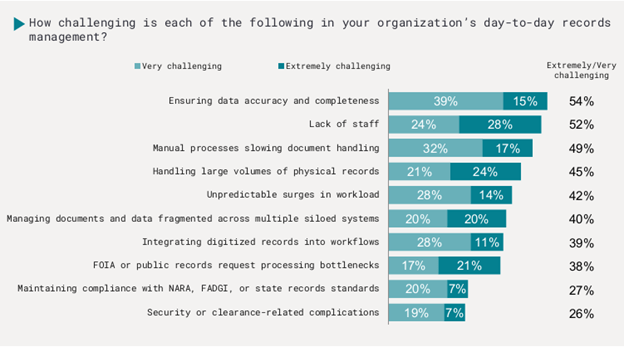
Methodology: GovExec Intelligence deployed a 4-question poll to a random sample of 100 federal and state government records management decision-makers and influencers, fielded in January 2026
Read the report for what to do next.
The whitepaper goes deeper on practical approaches agencies are using to reduce manual intake and review, plus how to handle the growing complexity of digital records and the rising expectations for defensible audit trails.
Download the whitepaper: Neugestaltung von Behördenakten im Zeitalter der KI
Learn more about our solutions: purpose-built for public sector agencies in highly regulated environments.


Gartner® erkennt Tungsten Automation in seinem ersten Magic Quadrant™ für Intelligent Document Processing (IDP) -Lösungen als führenden Anbieter an.
Bericht abrufenVerwandte Ressourcen

Kontaktieren Sie uns
Vernetzen Sie sich mit einem Experten von Tungsten Automation, um mehr über unsere Lösungen zu erfahren.

Demo anfordern
Erfahren Sie in einer personalisierten Demoversion aus erster Hand, wie wir Ihnen in Sachen Innovationen und Produktivität unter die Arme greifen und Sie dabei unterstützen können, Ihren Geschäftserfolg voranzutreiben.